All 3 shed bases in this collection, ranked on size for the money, guarantee and features. Use the finder to narrow them down.
Why it ranks here: low price per sq ft for a shed base, 2-year guarantee.
Why it ranks here: mid-range price per sq ft, 2-year guarantee.
Why it ranks here: higher price per sq ft than most, 2-year guarantee.
How we score. The value score is our own sum from the listed specs and Shedstore's price. It is not a customer review and we have not tested the products. For a shed: 45% is price per square foot against other sheds, 25% is guarantee length, 20% is features (floor, windows, lock, double doors) and 10% is any saving off the RRP. Bases are scored on price per square foot and guarantee, storage boxes on price per litre, guarantee and lock. Give us your space and it becomes a match score that also rewards the products that make best use of it.
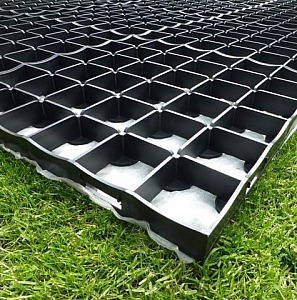
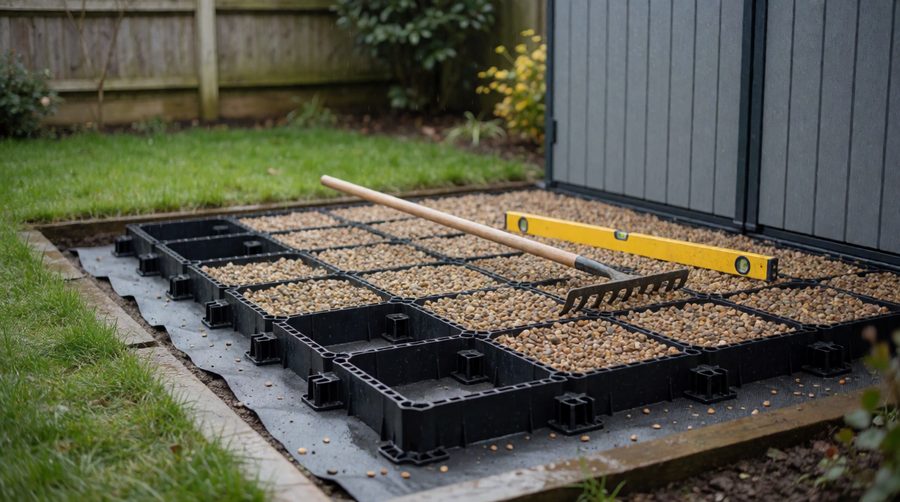
8x6 shed bases give a garden shed of around 2.4 x 1.8m a flat, firm and free-draining platform without mixing a bag of concrete. Every one is a ProBASE base kit: 500mm squares of high quality recycled plastic that clip together on a weed membrane and get filled with gravel.
Shedstore doesn't sell a 20-square kit for this size, so this page lists the three ProBASE packs closest to it, and the guide below shows how the 25-square 8x7 pack covers one with room to spare. Still choosing the shed? See our 8x6 plastic sheds, or every size in our shed bases range.
A shed's name is rarely its exact size, as most are a few centimetres over or under 8ft by 6ft. Take the external floor size in metres from the shed's listing, then pick a platform that's the same size or a little bigger. A ProBASE square is 500 x 500mm and 40mm deep, so a finished platform always grows in steps of half a metre.
That makes the sum simple. Most sheds this size need a platform 5 squares long and 4 squares wide, which is 2.5 x 2.0m and 20 squares. Shedstore sells these in 15, 18 and 25-square kits, so the 25-square 8x7 kit is the one to buy. Lay 20 of the squares under the shed and keep the other 5 as a spare row or a dry step outside the door.
The squares clip together on every side, so you aren't stuck with the shape the kit's name suggests. The maker publishes layout ideas for different footprints on the ProBASE website.
Here are the three kits on this page. Platform is the real size of the finished base laid as a rectangle, and gravel is the total at the 15kg per square the maker advises. Prices change every day and the grid above always shows Shedstore's current price, so here they're in bands.
| Kit | Squares | Platform (m) | Area | Pea gravel | Best for | Price band |
|---|---|---|---|---|---|---|
| 8x5 kit | 15 | 2.5 x 1.5 | 3.75 sq m | 225kg | 7x5 and 8x5 sheds up to 1.5m deep | Under £125 |
| 10x4 kit | 18 | 3.0 x 1.5 | 4.5 sq m | 270kg | Long, narrow 10x4 and 9x4 sheds | Under £125 |
| 8x7 kit | 25 | 2.5 x 2.5 | 6.25 sq m | 375kg | Sheds up to 2.5 x 2.5m | £125 to £250 |
Every kit is the same system, just with a different number of squares. Here's what you get in each one.
Gravel isn't in the box. The listing recommends 10mm pea gravel, so book a delivery from a builders' merchant for the same week the kit arrives.
The 8x5 and 10x4 packs are both only 1.5m deep, which is too shallow for a 6ft deep shed. They suit a 7x5 shed, a narrow pent shed against a fence, a log store or a bike store.
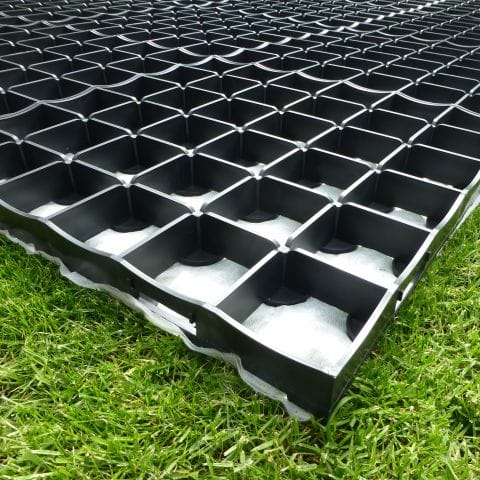
These are the real footprints of the sheds this size we list, with the grid layout that covers each one. Every one of them fits on a single 8x7 kit.
| Shed | External size | Grid layout | Platform | Squares used |
|---|---|---|---|---|
| Keter Factor | 2.57 x 1.82m | 6 x 4 | 3.0 x 2.0m | 24 of 25 |
| Keter Darwin | 2.44 x 1.90m | 5 x 4 | 2.5 x 2.0m | 20 of 25 |
| Palram Canopia Rubicon 6x8 | 1.85 x 2.28m | 4 x 5 | 2.0 x 2.5m | 20 of 25 |
The Keter Factor is the one to watch. At 2.57m it's a few centimetres wider than the 2.5m a 5-square row gives, so lay the squares 6 long and 4 wide instead. That takes 24 of the 25 squares and leaves about 20cm of gravel at each end. Keter's own listing for the Darwin asks for a foundation of at least 1.93 x 2.44m, and the 2.5 x 2.0m layout clears it. More sizes are on our Keter Factor sheds and Palram sheds pages.
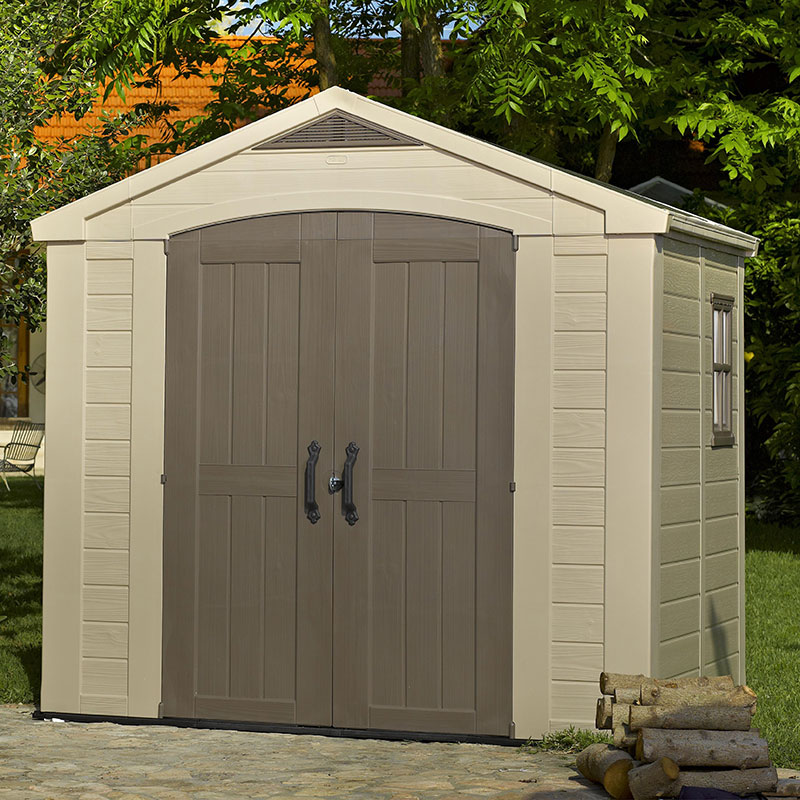
The same packs cover the sizes either side of this one.
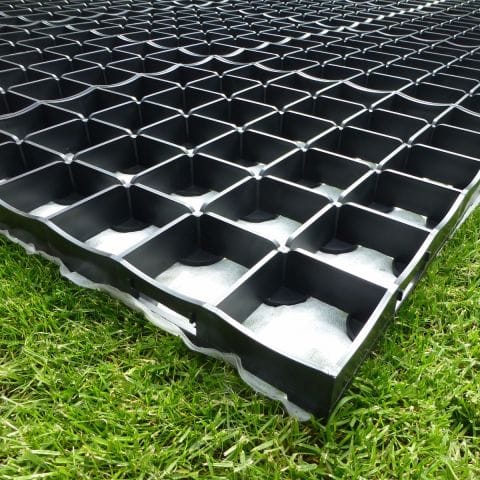
A grid base this size is a morning's work for two people. The ground prep takes longest. The squares are quick and easy to put together, so it's simple to assemble and install the base itself, with no concrete to mix and no special tools.
For a 20-square layout that's about 300kg of gravel, or 360kg for the 24-square Keter Factor layout. One bulk bag from a builders' merchant is usually enough, with some left to make a gravel strip around the walls. That strip works as a simple french drain, so rain doesn't splash mud up the panels.
Shedstore doesn't install these kits, so it's a DIY job, but a simple one. If you've booked its team to build the shed, the base has to be finished before they arrive.
Plastic and resin sheds are fussier than timber ones. Their wall panels slot into the floor, so if the base dips at one corner the frame twists, the doors stop meeting and panels can pop out of their channels. Many plastic sheds come with a floor, but even a built-in floor needs a firm, flat surface under it. Our plastic sheds with floors page shows which models have one.
A gravel-filled base also keeps the shed floor dry. Water drains straight through the open squares, so the shed floor never sits on wet soil. That's what rots a timber floor and leaves damp inside. Light plastic sheds should be fixed down too. Our shed security range has ground anchors and locks.
A plastic kit isn't the only choice. Here's how the usual options compare for a shed this size.
For a flat lawn, a kit filled with gravel is usually the cheapest and easiest of these. You can also lift it and lay it again if you ever move the shed.
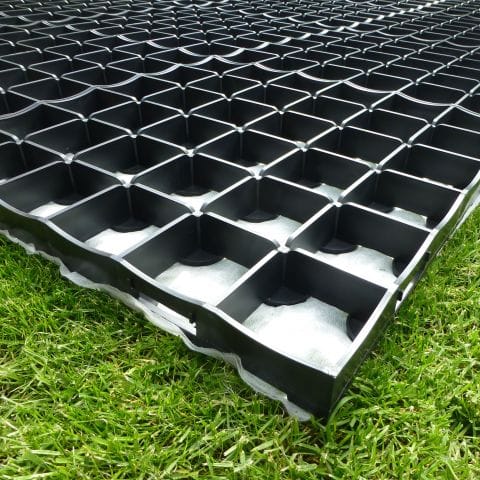
Usually not in England. A shed counts as permitted development if it stays behind the front of the house, is single storey, and covers no more than half the garden. Within 2m of a boundary it must be no more than 2.5m tall, so check the height on the shed's listing. The Planning Portal guide to outbuildings has the details, and the government's permitted development technical guidance explains how height is measured. A 40mm grid base adds almost nothing to that height. Listed buildings, flats and conservation areas have extra rules, and Wales, Scotland and Northern Ireland set their own.
ProBASE does make a 20-square pack for this size, but Shedstore sells the 25-square 8x7 kit instead. Lay 20 squares as a 2.5 x 2.0m rectangle and you have the same base, plus 5 spares.
About 300kg of 10mm pea gravel for 20 squares, at the 15kg per square ProBASE recommends. Allow more if you want a gravel strip around the shed.
Yes, for these kits. Shedstore's listing for every pack recommends 15kg of 10mm pea gravel per square. The gravel adds weight and strength and locks the squares in place.
Not straight onto turf. Strip the grass and soft topsoil, compact the ground and check it's level, then lay the membrane and grids.
It should be at least as big as the shed's outside footprint, and a little bigger is better. A margin of gravel keeps the walls clear of soil and grass.
Each kit has a 2 year guarantee from the maker, and comes with instructions and customer service support. The recycled plastic won't rot, so a base laid on well-drained ground should outlast that by a long way.
Yes. Nothing is glued or cast in place, so you can rake out the gravel, unclip the squares and lay them again somewhere else.
